
The Cognitive Debt Crisis:
Why the Future of AI Depends on Preserving Human Thinking
AI EDUCATIONAICOGNITIVE DEVELOPMENT
ninth dimension
5/8/20263 min read
Beyond Reality. Beyond Limits.
We live in a world obsessed with acceleration.
Faster tools.
Faster workflows.
Faster outputs.
Faster intelligence.
Artificial Intelligence has become the ultimate acceleration engine.
In seconds, AI can:
generate business strategies
write code
summarize books
create designs
produce research
automate communication
simulate expertise
And while the world celebrates productivity gains, a far more important question is emerging beneath the surface:
What happens when we optimize performance faster than cognition itself?
This is the beginning of what we call:
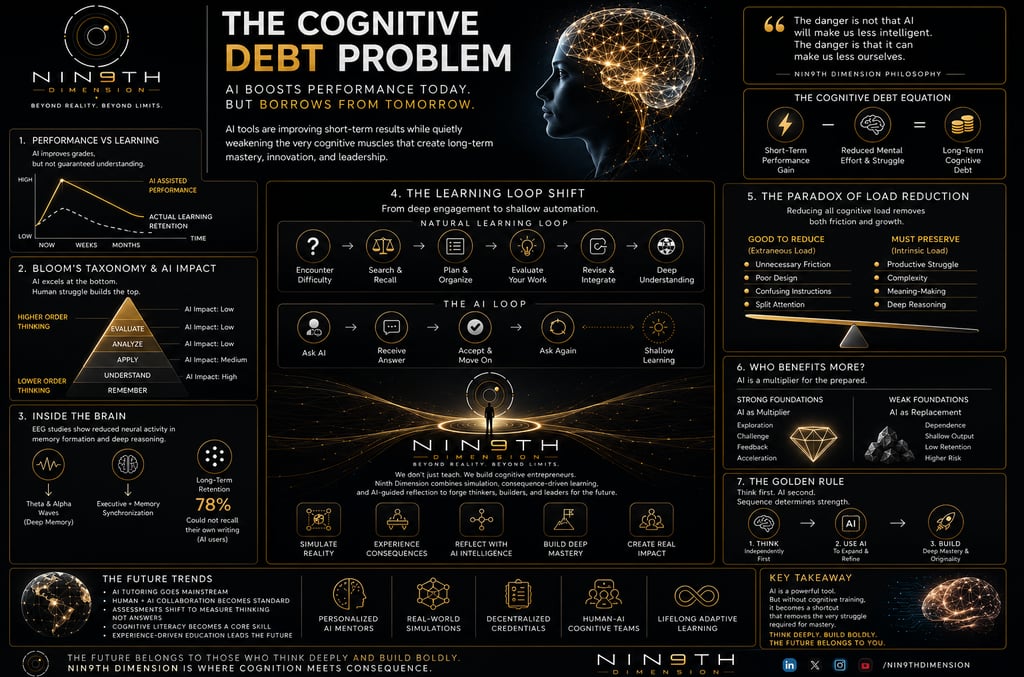
Cognitive Debt.
A hidden long-term cost created when human thinking is increasingly outsourced to artificial systems.
And it may become one of the defining challenges of the AI era.
The Illusion of Intelligence
One of the most dangerous characteristics of AI is that it creates the appearance of mastery.
People can now:
generate ideas without understanding systems
write code without learning logic
create strategies without developing judgment
produce content without original thought
The output appears intelligent.
But the cognition behind the output may be weakening.
This is where cognitive debt begins.
Unlike technical debt or financial debt, cognitive debt compounds silently.
You don’t feel it immediately.
It accumulates gradually through:
reduced critical thinking
dependency loops
shallow comprehension
fragmented attention
passive learning patterns
externalized reasoning
Over time, the brain begins adapting to convenience.
And that adaptation changes how humans learn, retain, and think.
AI Is Not the Problem
Passive cognition is.
This distinction matters enormously.
AI itself is not inherently dangerous.
In fact, AI may become one of humanity’s greatest amplification systems.
The real danger emerges when AI shifts from:
enhancing cognition
to:
replacing cognition
There is a profound difference between:
“AI helping humans think better”
and
“Humans slowly losing the need to think deeply.”
That distinction may define the future of innovation itself.
The Cognitive Collapse Nobody Notices
The scariest aspect of cognitive debt is invisibility.
People still feel productive.
Assignments get completed faster.
Presentations look polished.
Code ships quicker.
Content scales endlessly.
But internally:
mental endurance declines
deep focus weakens
systems thinking erodes
strategic clarity reduces
originality becomes pattern recombination
Eventually:
teams stop questioning assumptions
founders lose long-term strategic thinking
students lose deep learning ability
creativity becomes algorithmic recycling
The external output remains high.
But the internal cognitive architecture weakens.
The Brain Was Never Designed for Infinite Convenience
Human intelligence evolved through:
friction
struggle
uncertainty
adaptation
consequence
The brain develops strength through effort.
Deep learning requires:
retrieval
synthesis
evaluation
reflection
experimentation
When every difficult cognitive step becomes automated, the brain slowly reduces engagement in those processes.
This is neurologically efficient.
But cognitively dangerous.
The problem is not that AI gives answers.
The problem is when humans stop building the mental structures required to evaluate those answers independently.
Why Simulation Matters More Than Information
At Ninth Dimension, this realization changed how we think about learning itself.
The future of intelligence may not belong to static education systems.
It may belong to:
simulations
experiential learning
consequence-driven environments
adaptive cognition systems
Because humans learn deepest through:
experience
emotional engagement
strategic decision-making
failure
iteration
consequence
This is why games teach effectively.
This is why entrepreneurship creates rapid growth.
This is why simulation-based cognition may become essential in the AI era.
From Passive Learning to Cognitive Training
Most educational systems optimize for:
memorization
completion
standardization
testing
But the future economy increasingly rewards:
systems thinking
adaptability
creativity
judgment
interdisciplinary reasoning
cognitive resilience
That requires a different type of learning architecture.
One that does not simply deliver answers.
But develops thinkers.
This is the philosophy behind Ninth Dimension.
Not an AI system that replaces cognition.
But an ecosystem designed to strengthen it.
The Future Will Divide Into Two Groups
As AI becomes universal, the world may split into two categories:
1. AI-Dependent Operators
People who rely on AI for:
reasoning
strategy
judgment
decision-making
idea generation
These individuals may move fast.
But risk shallow cognition.
2. AI-Augmented Thinkers
People who preserve:
first-principles reasoning
deep thinking
strategic synthesis
adaptive intelligence
while using AI as an amplifier.
These individuals will likely dominate:
innovation
leadership
entrepreneurship
scientific discovery
creative industries
Because future advantage will not come from access to AI.
Everyone will have access.
The advantage will come from:
the quality of human cognition directing AI systems.
The Rise of Cognitive Resilience
One of the most valuable future skills may become:
Cognitive Resilience
The ability to:
think independently
maintain deep focus
reason under uncertainty
resist passive automation
build internal mental models
adapt strategically
In a world of infinite information, deep thinking becomes rare.
And rare cognition becomes valuable.
Why Ninth Dimension Exists
Ninth Dimension was never meant to be just another platform.
It emerged from a deeper question:
How do we build systems that strengthen human intelligence instead of replacing it?
That vision led toward:
entrepreneurial simulations
consequence-driven learning
adaptive AI mentors
real-world strategic environments
immersive decision systems
experiential cognition architecture
The goal is not merely to teach entrepreneurship.
The goal is to train:
thinkers
builders
strategists
adaptive minds
Because the future does not belong to people who simply consume intelligence.
It belongs to those who can direct it.
Final Thought
The greatest risk of AI is not that machines become intelligent.
The greatest risk is that humans become passive.
The future will not be won by those who automate everything.
It will be won by those who preserve deep human cognition while intelligently integrating AI.
That is the balance humanity must learn.
And that is the future we are building toward.